


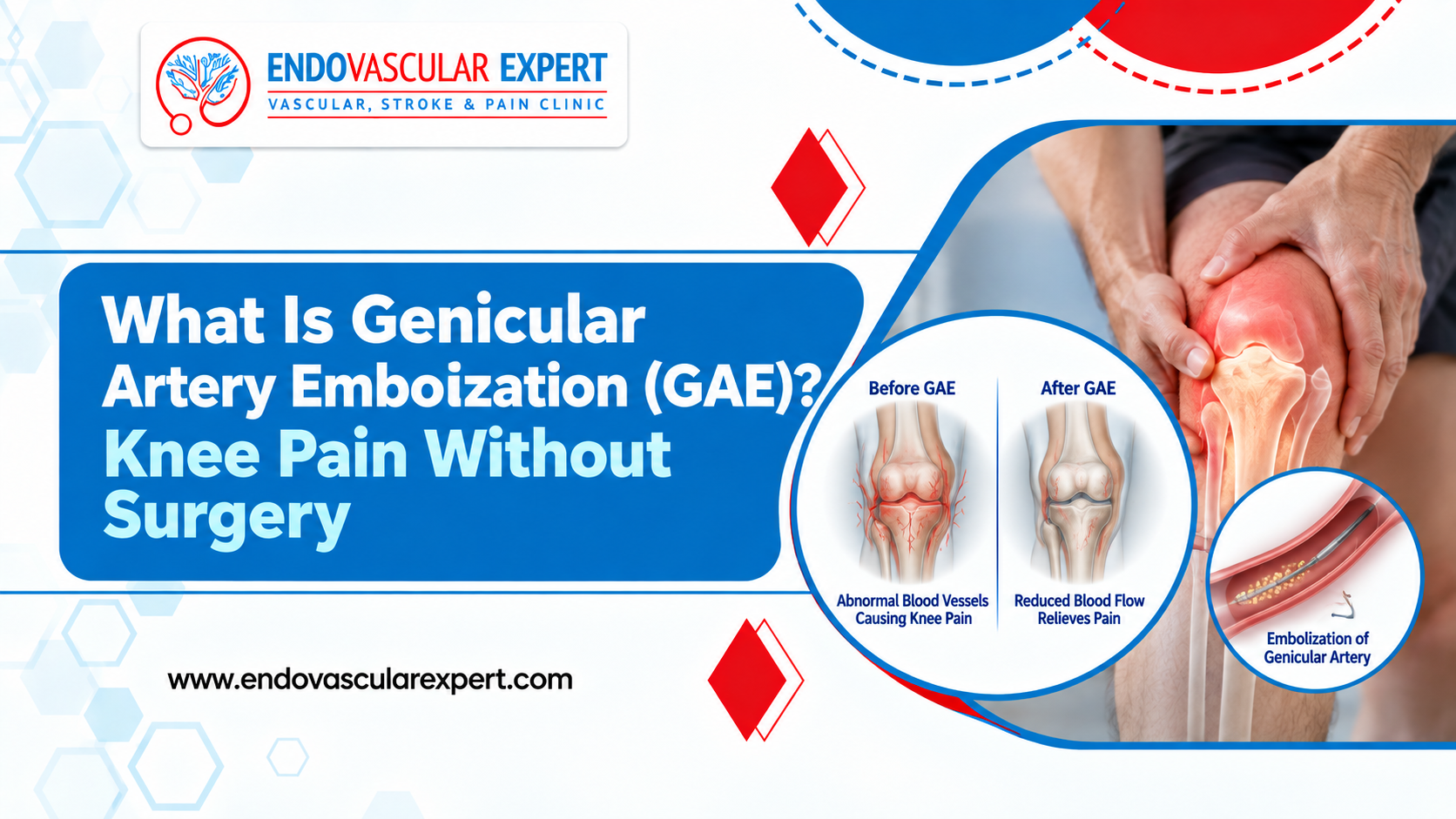
If you have knee osteoarthritis, you have probably been offered two things: painkillers now, and a knee replacement “when it gets bad enough”. For many people there is a large, frustrating gap in between. Genicular Artery Embolization (GAE) is a newer, minimally invasive option designed for exactly that gap — a pinhole, day-care procedure for knee pain that hasn’t settled with medication, physiotherapy or injections.
The Idea in One Paragraph
In an arthritic knee, the inflamed lining grows abnormal tiny blood vessels, and these carry extra nerve fibres that amplify pain. In GAE, an interventional radiologist threads a fine catheter to the small genicular arteries around the knee and releases microscopic particles to reduce that abnormal blood flow. Less abnormal flow means less inflammation-driven pain. The cartilage isn’t cut, the joint isn’t opened.
Who is it for?
- Mild to moderate knee osteoarthritis with persistent pain despite tablets, physiotherapy and/or steroid injections.
- People who are not ready for, or not fit for, knee replacement surgery.
- Those wanting to postpone a joint replacement, or bridge the wait.
It is not a replacement for surgery in an end-stage, bone-on-bone knee — that patient may genuinely need a joint replacement. GAE fits earlier in the journey.
What the Procedure Day Looks Like
Access is a pinhole in the groin or wrist under local anaesthesia. Using live X-ray imaging, the doctor maps the genicular arteries and delivers the embolic particles precisely. The procedure typically takes about an hour. It is done as day-care — most patients go home the same day and walk out. Because there’s no incision into the joint, there is no wound to heal.
What Results to Expect
In published early studies, a majority of appropriately selected patients report meaningful pain reduction that builds over weeks and can last months to a couple of years. It is an evolving field, and honesty matters: GAE relieves pain and improves function for many, but it does not regrow cartilage or “cure” arthritis. Realistic expectations are part of good care.
Stuck between painkillers and a knee replacement? Ask whether GAE is an option for you. Dr. Nikhil Bansal (MD, PGDHHM, FVIR, FIPM), Interventional Radiologist in Jaipur, assesses knee osteoarthritis pain and image-guided treatment in Jaipur.
Frequently Asked Questions
Is genicular artery embolization a replacement for knee surgery?
No. GAE is aimed at mild-to-moderate osteoarthritis pain that hasn’t responded to medicines and injections, and at people not ready for surgery. An end-stage, bone-on-bone knee may still need a joint replacement.
Is GAE a day-care procedure?
Yes. It is done through a pinhole under local anaesthesia and most patients go home the same day and walk out.
How long does pain relief last after GAE?
In published early studies, many appropriately selected patients get meaningful relief lasting months up to a couple of years. It reduces pain but does not regrow cartilage.
Disclaimer: This article is for education only. GAE is an evolving treatment; suitability must be assessed individually by a qualified specialist.