


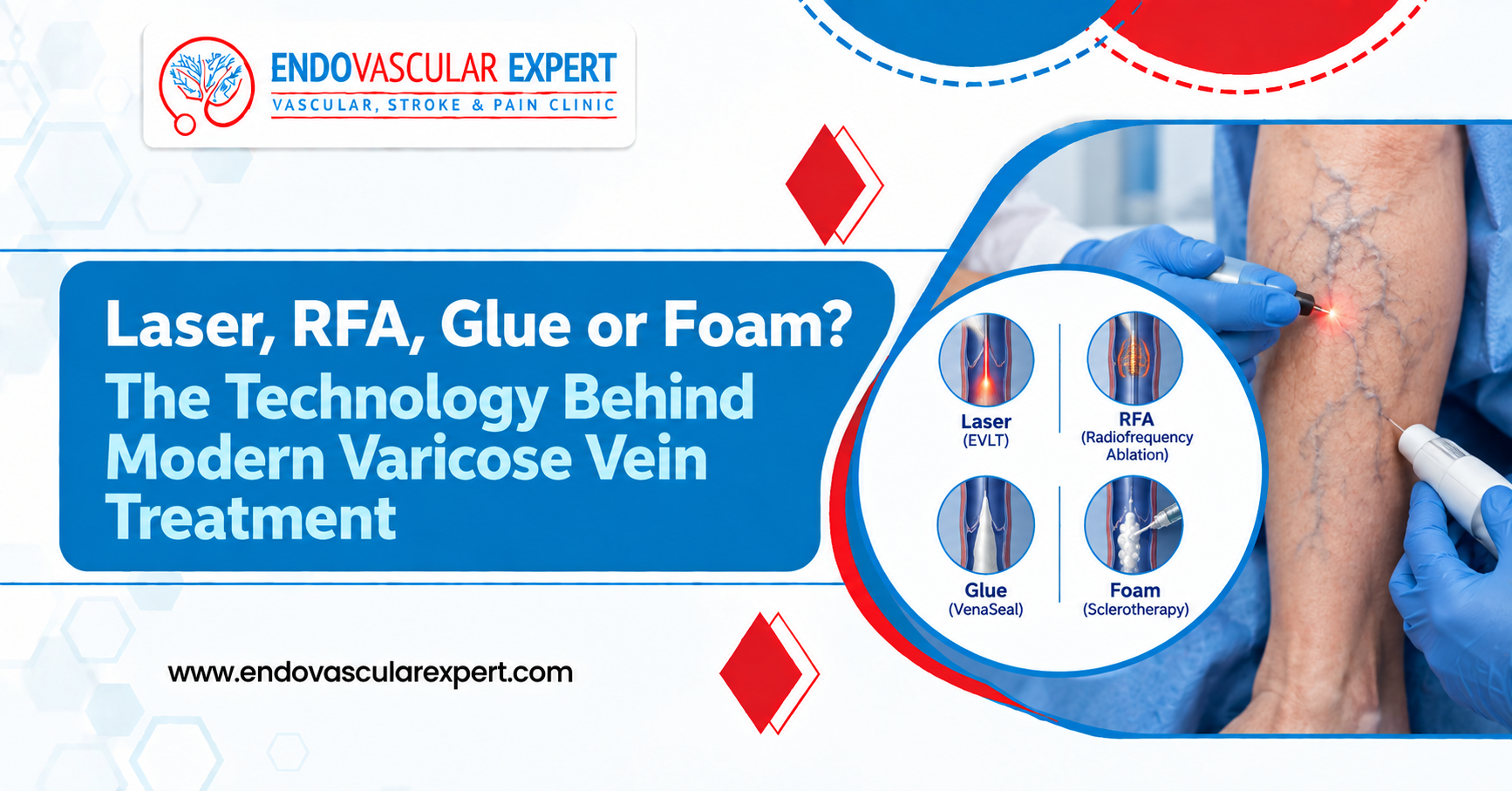
Every clinic advertises “pinhole” and “laser” for varicose veins, and the words start to blur. But these are genuinely different technologies, and the right one for you depends on your vein anatomy — not on which machine a clinic happens to own. Here is what each technology does, in plain language, and why the diagnosis (the ultrasound map) matters more than the device.
First, The Thing They All Have in Common
All modern treatments share one principle: instead of pulling the faulty vein out (old-style stripping surgery), we seal it shut from the inside through a pinhole, and the body reroutes blood through healthy deep veins. Every one of them is guided by ultrasound. This is why the specialty is interventional radiology — the imaging is the surgery.
EVLT — Endovenous Laser (heat)
A thin laser fibre is passed inside the vein through a pinhole. Laser energy heats the vein wall so it collapses and seals. Varicose Veins Laser Surgery is a workhorse for the main truncal veins (the great and small saphenous veins) with published one-year closure rates around 94–98%. Needs tumescent local anaesthesia around the vein to protect skin and nerves.
RFA — Radiofrequency Ablation (heat)
Radiofrequency uses controlled radio-wave heat instead of laser light, delivered in segments. Many patients report slightly less bruising and post-procedure discomfort than laser. Closure rates are comparable to laser. Also needs tumescent anaesthesia.
VenaSeal — Medical Glue (non-thermal)
A medical-grade cyanoacrylate adhesive is injected to glue the vein shut — no heat at all. Because there is no thermal energy, there is no risk of heat-related nerve injury and usually no need for tumescent anaesthesia or compression stockings. Ideal for needle-shy patients or veins near sensitive nerves. Trial closure rates are around 94–97% at one year. It is available at our clinic and is chosen when the anatomy suits it — not as a brand name, but as the right tool for the right vein.
MOCA — Mechanochemical Ablation (non-thermal)
MOCA combines a rotating catheter tip that irritates the vein wall with a liquid sclerosant. No heat, so no tumescent anaesthesia needed — useful for longer straight vein segments where avoiding nerve heating is a priority.
Foam Sclerotherapy (injection)
Sclerotherapy injects a foamed medicine that irritates and closes smaller veins. It is the finishing tool — perfect for spider veins, reticular veins and residual branches after a main vein has been ablated. Often used alongside laser/RFA rather than instead of it.
So Which is Best?
The honest answer: the best technology is the one that matches your ultrasound findings. A large, straight saphenous vein may be ideal for laser or RFA. A vein hugging a nerve may be safer with glue or MOCA. Spider veins need foam. Someone who cannot tolerate stockings may prefer glue. This is exactly why a proper colour Doppler vein mapping comes before any talk of which device — treating without it is like operating with the lights off.
Not sure which treatment fits your veins? Dr. Nikhil Bansal (MD, PGDHHM, FVIR, FIPM) maps your veins first, then recommends the technology that suits your anatomy — laser, RFA, glue, MOCA or foam.
Frequently Asked Questions
Which is better, laser or VenaSeal glue?
Both have high closure rates. Laser needs tumescent anaesthesia and compression stockings; glue usually needs neither and avoids any heat near nerves. The better choice depends on your vein’s size, path and how close it runs to a nerve — decided after ultrasound mapping.
Is “pinhole treatment” the same as laser?
“Pinhole” just describes the tiny access point used by all these techniques — laser, RFA, glue and MOCA are all pinhole procedures done by an interventional radiologist. It is not a separate treatment.
Do I need stockings after treatment?
Usually 1–2 weeks after thermal treatments (laser/RFA). After VenaSeal glue, compression stockings are often not required.