


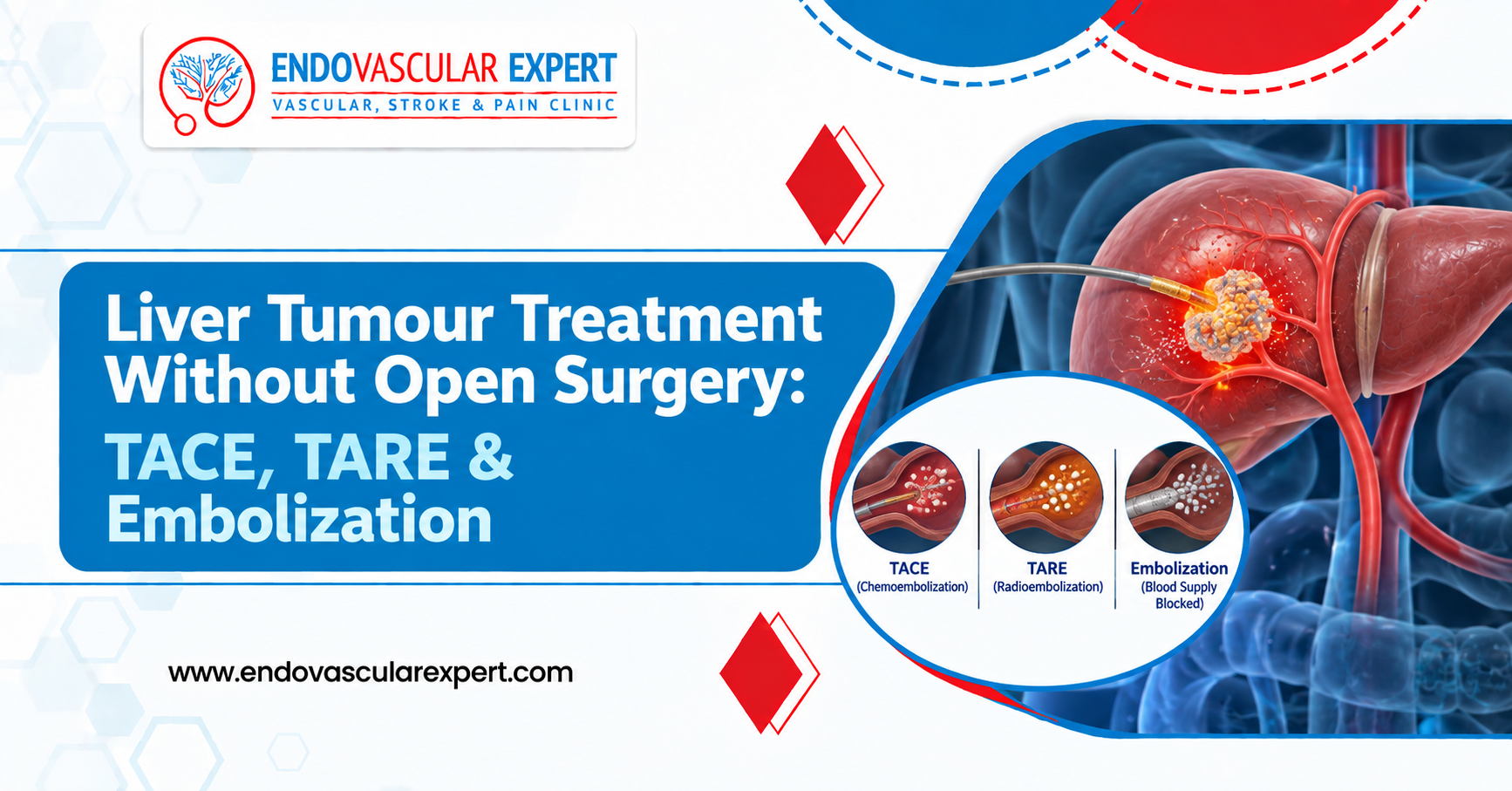
When a scan shows a liver tumour, most families assume the only options are major open surgery or chemotherapy. There is a third route that many patients in Rajasthan don’t know exists: interventional oncology — treating the tumour directly through a pinhole in the wrist or groin, guided by imaging, without a single large cut. This is the field an interventional radiologist works in. Here is what TACE, DEB-TACE and TARE actually mean.
The Idea Behind Embolization
A liver tumour grows its own blood supply, drawing most of its nourishment from the hepatic artery — while healthy liver tissue is fed mainly by a second vessel, the portal vein. That difference is the key. By threading a fine catheter into just the artery feeding the tumour, we can deliver treatment straight to the cancer and block its blood supply, while largely sparing the normal liver. No abdomen is opened; access is a needle-puncture.
TACE — Trans-Arterial Chemo-Embolization
In TACE, concentrated chemotherapy is injected into the tumour’s artery and the vessel is then blocked with tiny particles. The drug stays trapped inside the tumour at a much higher dose than intravenous chemo would allow, while the rest of the body is exposed to far less. It is one of the standard treatments for intermediate-stage hepatocellular carcinoma (primary liver cancer).
DEB-TACE — Drug-Eluting Bead TACE
A refinement of TACE. The chemotherapy is loaded onto microscopic beads that lodge in the tumour vessels and release the drug slowly over days. This can mean a more sustained effect and, in many patients, fewer whole-body side effects than conventional TACE.
TARE / Radioembolization (Y-90)
In TARE, the beads delivered into the tumour’s artery carry a radioactive isotope (yttrium-90) instead of a drug. They deliver a high, targeted dose of radiation from inside the tumour. It is used for certain liver cancers and for cancers that have spread to the liver from elsewhere, and is generally very well tolerated as a day-care or short-stay procedure.
Which One, For Whom?
There is no single “best” — the choice depends on tumour type, size and number, how well the liver is working, whether the portal vein is involved, and the patient’s overall condition. That decision is made by reading the imaging and liver function together, ideally in a tumour-board discussion. What these treatments share is the delivery route: a pinhole, image-guided, with a typical hospital stay of one to two days rather than the week or more of open liver surgery.
What Recovery Looks Like
Some patients experience “post-embolization syndrome” for a few days — low-grade fever, nausea and right-sided discomfort as the tumour is treated. This is expected and manageable, not a complication. Most people are back to normal routines within one to two weeks and return for a follow-up scan to measure the tumour’s response.
Do you have a liver tumour report you want reviewed? Dr. Nikhil Bansal (MD, PGDHHM, FVIR, FIPM), Interventional Radiologist in Jaipur, offers image-guided liver tumour treatment (TACE, DEB-TACE, TARE) in Jaipur. You can send scan reports for an initial opinion.
Frequently Asked Questions
Is TACE a cure for liver cancer?
TACE is a highly effective control treatment that can shrink tumours, relieve symptoms and, in selected patients, keep the disease in check for long periods or bridge them to transplant. Whether it is curative depends on the stage and type — this is discussed individually.
How is TACE different from normal chemotherapy?
Normal chemo circulates through the whole body. TACE delivers the drug directly into the tumour’s artery and then blocks that artery, so the tumour receives a much higher dose while the rest of the body is exposed to much less.
Is the procedure done under general anaesthesia?
No. It is done through a pinhole in the artery under local anaesthesia with sedation, guided by live X-ray imaging. Most patients stay in hospital for one to two days.