


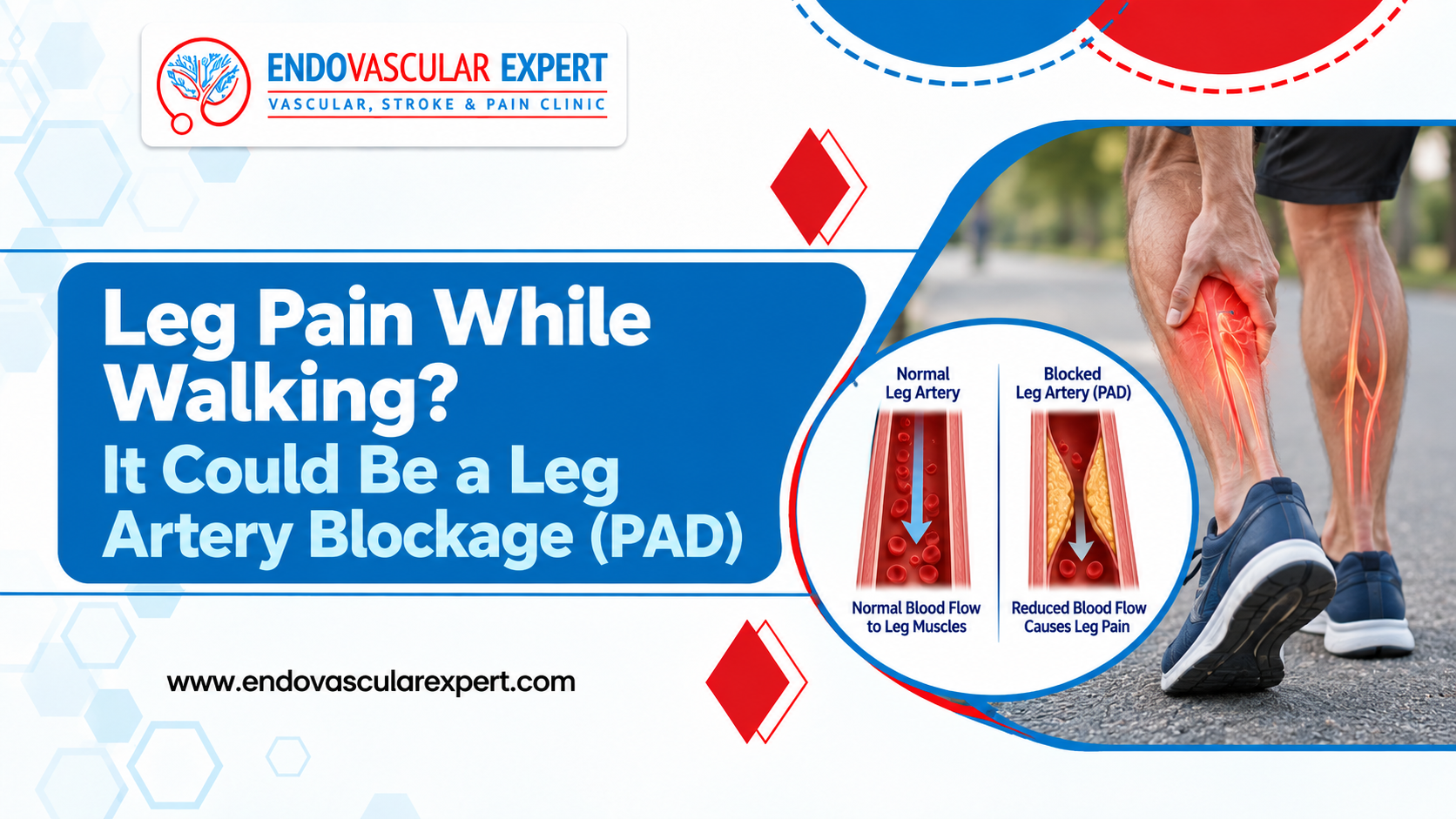
A cramping pain in the calf that starts after walking a certain distance and eases when you stop is easy to dismiss as “just age” or “weakness”. It is often something specific and treatable: peripheral artery disease (PAD) — narrowing of the arteries that carry blood to the legs. Caught early, it is manageable. Ignored, it is a leading cause of non-healing foot wounds and, in the worst cases, amputation. The good news: most blockages can now be opened through a pinhole.
Warning Signs You Should Not Ignore
- Intermittent claudication — cramping pain in the calf, thigh or buttock that comes on with walking and eases with rest.
- Cold, pale or bluish feet compared with the rest of the body.
- A wound, ulcer or sore on the foot or toes that will not heal, especially in people with diabetes.
- Rest pain — aching in the foot at night that improves when you hang the leg off the bed.
- Weak or absent pulses in the foot (something a doctor checks).
People with diabetes, smokers, and those with high blood pressure or kidney disease are at particular risk — and in diabetes the classic “pain” warning can be blunted by nerve damage, so a slow-healing wound may be the first sign.
Why It Matters: The Diabetic Foot Connection
A foot ulcer that refuses to heal is very often a blood-supply problem, not just a skin problem. No dressing, antibiotic or ointment heals a wound that isn’t getting enough blood. Checking and restoring the arterial supply is frequently the missing step — and it is the difference between healing and losing toes. If you or a family member has a Diabetic Foot Ulcer, the arteries deserve to be assessed.
Diagnosis: Simple and Painless
Assessment usually starts with pulse examination and an ankle-brachial index (a blood-pressure comparison between arm and ankle), followed by a Colour Doppler ultrasound and, where needed, a CT or catheter angiogram to map the exact site of blockage.
Treatment: Pinhole Angioplasty
For most blockages, an interventional radiologist can restore flow without open bypass surgery. Through a needle-puncture in the groin, a fine wire is guided across the blockage under X-ray, a balloon is inflated to open the artery (angioplasty), and a stent is placed if needed to keep it open. Newer drug-coated balloons help keep the vessel open longer. It is done under local anaesthesia, often as a short-stay procedure, and blood flow to the leg is restored the same day.
Limb Salvage — The Real Goal
In advanced PAD with tissue loss (critical limb ischaemia), timely angioplasty is a limb-saving procedure. Restoring flow gives ulcers the blood they need to heal and can prevent a minor wound becoming a major amputation. Time matters — the earlier the artery is opened, the more of the foot can be saved.
Leg pain on walking, or a wound that won’t heal? Get the arteries checked before it progresses. Dr. Nikhil Bansal (MD, PGDHHM, FVIR, FIPM), Interventional Radiologist in Jaipur, performs pinhole angioplasty for leg artery blockage in Jaipur.
Frequently Asked Questions
Can a leg artery blockage be treated without surgery?
Yes — most blockages can be opened with pinhole angioplasty and stenting through a needle puncture, without open bypass surgery, under local anaesthesia.
Is calf pain while walking always PAD?
Not always, but cramping calf pain that reliably comes on with walking and eases with rest is a classic PAD symptom and should be evaluated, particularly in smokers and people with diabetes.
Can angioplasty save a leg from amputation?
In advanced disease with a non-healing wound, timely restoration of blood flow can allow ulcers to heal and prevent progression to amputation. Early treatment gives the best chance.