


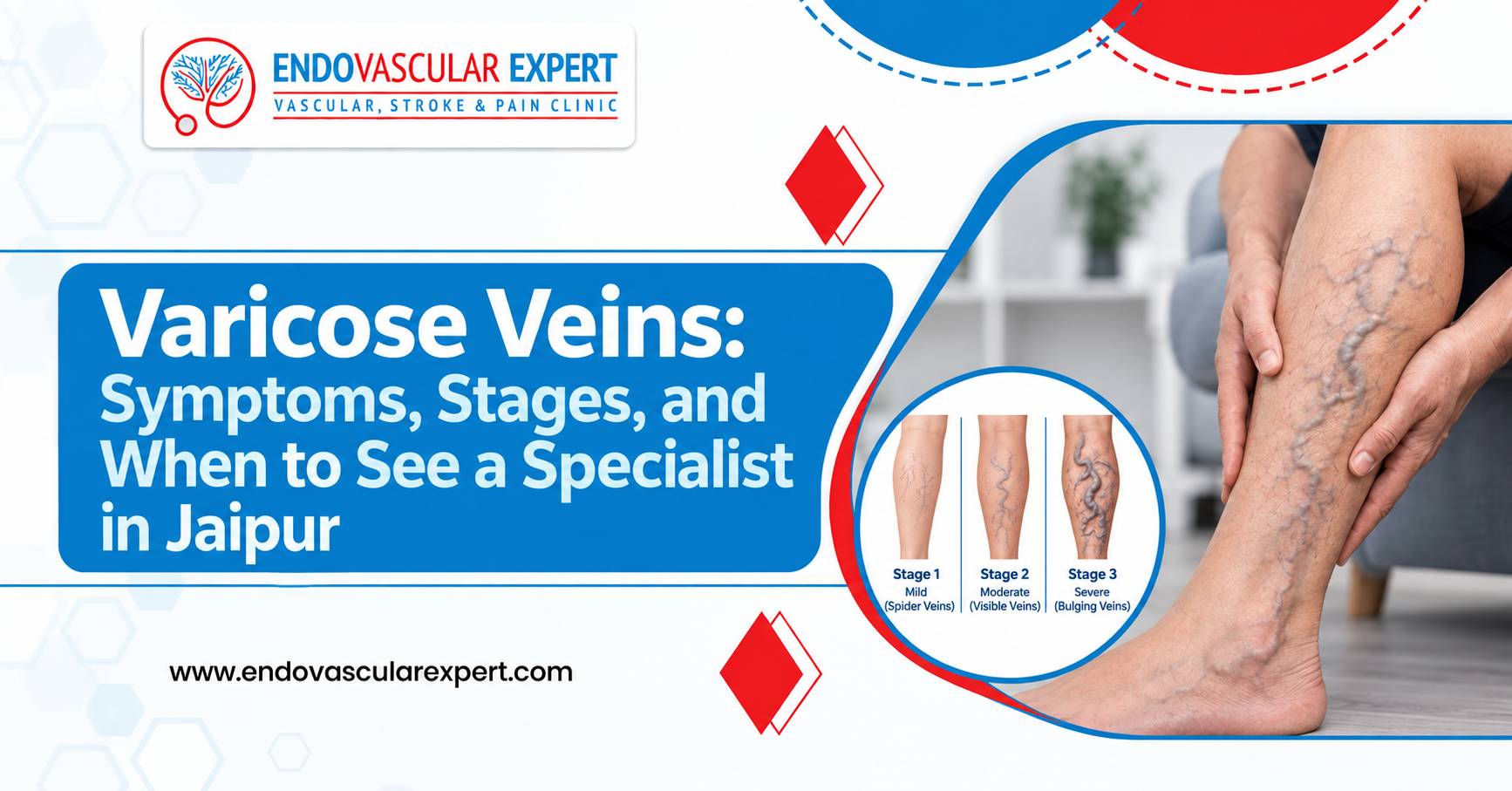
Most people wait years too long. Varicose veins progress slowly enough that aching legs get blamed on age, standing jobs, or “just how my legs are” — until skin changes or a clot forces the issue. This guide walks the stages of vein disease, the symptoms at each, and the point at which you should see a specialist. For varicose veins evaluation and treatment in Jaipur, that specialist is Dr. Nikhil Bansal, Consultant Endovascular & Interventional Radiologist in Jaipur.
The Stages of Vein Disease — Where Are You?
Stage 1 — Spider veins. Fine red-purple webs on the skin. Cosmetic at this stage, but a signal to watch.
Stage 2 — Visible varicose veins. Rope-like, bulging veins, usually behind the knee or along the inner calf. Often painless at first — which is exactly why they get ignored.
Stage 3 — Symptoms. Heaviness and aching by evening, night cramps, itching over the veins, restless legs, ankle swelling that resolves overnight. Daily life is now being taxed.
Stage 4 — Skin changes. Darkening (pigmentation), hardening, or eczema around the ankle. This is the warning stage: the skin is being damaged by venous pressure.
Stage 5–6 — Ulceration. Healed or open sores near the ankle. Entirely preventable with earlier treatment, and still very treatable now — but harder.
When to Book the Appointment
See a specialist now if any of these is true:
- Bulging veins plus any daily symptom (ache, heaviness, cramps, itching);
- Ankle swelling that returns every evening;
- Any darkening or hardening of skin near the ankle;
- A vein that has bled, or a tender hard lump along a vein (possible clot — treat this as urgent);
- Spider veins that are spreading, if their appearance bothers you.
Two rules of thumb from practice: symptoms that are worse at day’s end and better in the morning point to vein disease; and once skin changes appear, “wait and see” is over.
What the First Visit Involves — And Doesn’t
It involves an ultrasound, not an operation. The first step with Dr. Bansal is a Doppler ultrasound that maps which valves are leaking. Fifteen painless minutes, and it converts guesswork into a plan. Many patients leave that visit needing only monitoring and compression guidance; those who need treatment get a specific, staged recommendation — laser (EVLT), radiofrequency ablation, or sclerotherapy — matched to the map.
It does not involve admission, anaesthesia, or commitment. Modern varicose vein treatment is a day-care, local-anaesthesia, walk-in-walk-out matter — a fact that surprises patients who postponed for years fearing surgery.
Why Patients Choose Dr. Bansal
Dr. Nikhil Bansal is known in Jaipur for varicose veins treatment built on interventional radiology — the specialty of image-guided treatment. MD in Radiology; Fellowship in Vascular & Interventional Radiology (FVIR); 8 years of interventional practice; Assistant Professor, Department of Interventional Radiology, Mahatma Gandhi Hospital, Jaipur; a 4.9 Google rating from over a thousand treated patients. Every treatment he offers is ultrasound-guided and minimally invasive, and the recommendation follows your scan — for varicose veins in Jaipur, the evaluation starts with him.
Quick FAQ
Can varicose veins go away on their own?
No — valve failure doesn’t reverse. Symptoms can be managed early (compression, elevation, exercise), but the veins themselves only progress.
Are varicose veins dangerous?
Usually a quality-of-life disease, but stages 4+ damage skin, and superficial clots can occur. The point of early evaluation is keeping it a small problem.
I only have spider veins — is a specialist visit overkill?
No: a quick ultrasound rules out hidden trunk reflux feeding them. If it’s clear, cosmetic sclerotherapy is all you’d consider — on your timeline.
Is the Doppler ultrasound painful or does it need any preparation?
No preparation needed, and it’s completely painless — just gel and a probe over the leg, done in about 15 minutes. No fasting, no injections, no downtime before or after.
Are these treatments covered under RGHS or CGHS in Jaipur?
Yes — varicose vein treatment is available under RGHS and CGHS at this clinic. Ask about eligibility and paperwork at the time of booking your evaluation.
Does everyone with varicose veins need treatment?
No. Stage 1–2 (spider veins, painless bulging veins) often just need monitoring and compression stockings. Treatment becomes necessary once symptoms (Stage 3) or skin changes (Stage 4+) appear. The Doppler ultrasound is what tells you which category you’re in.
What does the evaluation cost me in time?
One visit, one ultrasound, one honest conversation.