


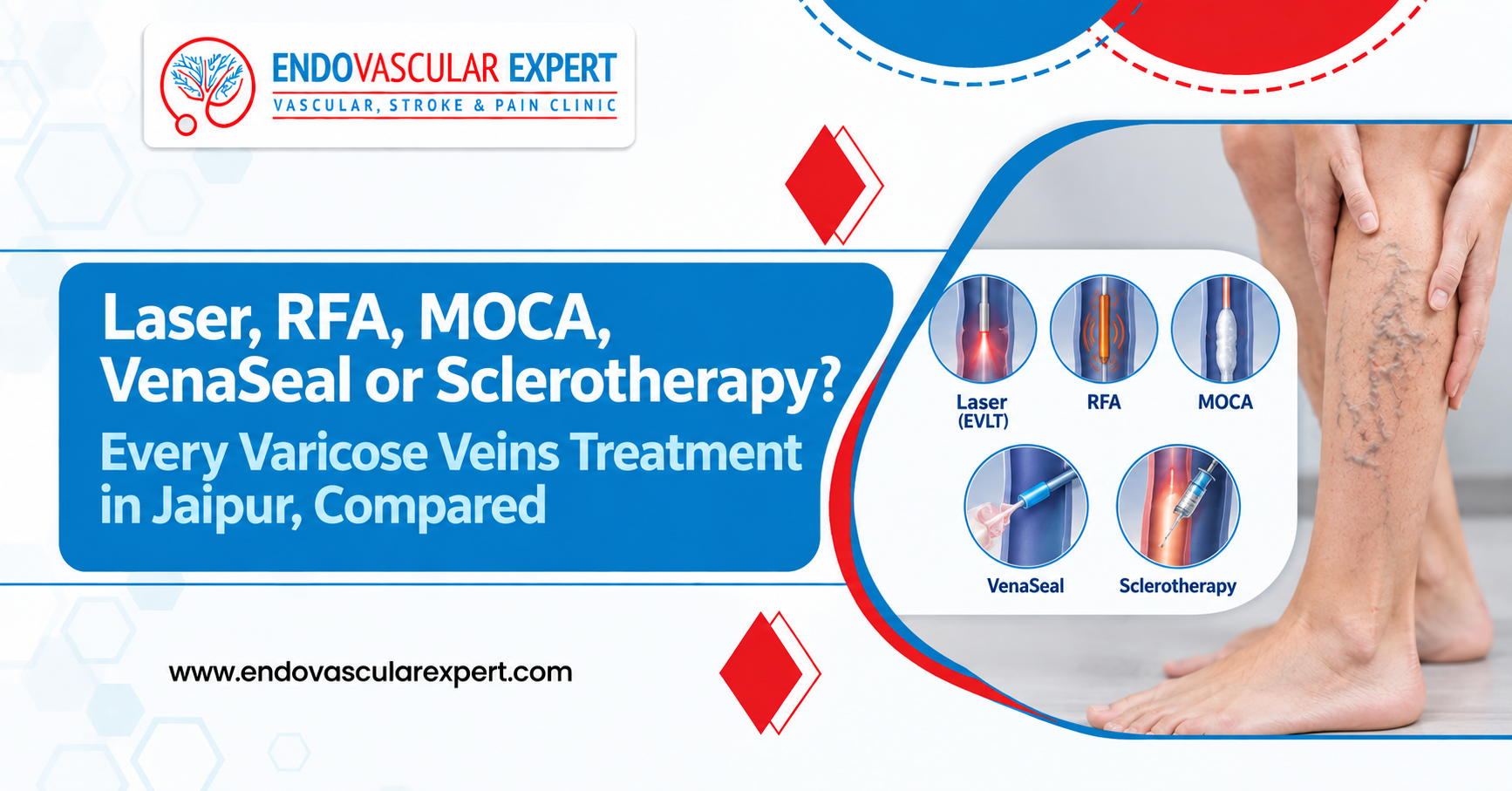
Search for varicose veins treatment in Jaipur and you’ll meet an alphabet of options: EVLT, RFA, MOCA, VenaSeal, sclerotherapy — plus the old surgery your parents’ generation feared. Which one is right depends on your ultrasound, not on marketing. Here is the whole menu, compared honestly, by the criteria that matter. For varicose veins treatment in Jaipur, Dr. Nikhil Bansal — interventional radiologist and Assistant Professor of Interventional Radiology at Mahatma Gandhi Hospital — plans treatment from exactly this comparison after mapping your veins with Doppler ultrasound.
The Comparison at a Glance
| Laser (EVLT) | Radiofrequency (RFA) | MOCA | VenaSeal (glue) | Sclerotherapy | Surgery (stripping) | |
| How it closes the vein | Laser heat, from inside | Radiofrequency heat, from inside | Mechanical scraping + chemical irritant, no heat | Medical adhesive, no heat | Injected sclerosant | Vein removed through incisions |
| Anaesthesia | Local (tumescent) | Local (tumescent) | Minimal local | Minimal local | None | Spinal/general |
| Cuts / scars | None | None | None | None | None | Yes |
| Walk out same day | Yes | Yes | Yes | Yes | Yes | No — admission |
| Best for | Main trunk reflux | Main trunk reflux (straighter veins) | Patients wanting less tumescent anaesthesia | Patients avoiding heat/tumescent anaesthesia | Spider veins, small branches, post-ablation finish | Rarely indicated today |
| Compression stockings after | Yes | Yes | Often shorter duration | Often not required | Yes | Yes |
| Long-term closure rates | >90% | >90% | High, comparable to thermal methods | >90% | Vein-by-vein | High, at surgical cost |
What Each Option Really Means
Endovenous laser (EVLT) — the workhorse. A laser fibre seals the refluxing trunk through a needle puncture under ultrasound. Twenty to forty minutes, walk out same day. Dr. Bansal performs EVLT as the standard answer to main-trunk reflux.
Radiofrequency ablation (RFA) — the same idea with radiofrequency energy instead of laser; some vein shapes and patient factors favour it, and closure rates are equivalent. Dr. Bansal performs Radiofrequency Ablation in Jaipur, which is exactly why his laser recommendations are credible: when a doctor offers both, the choice follows your anatomy.
MOCA (Mechanochemical Ablation) — closes the vein using a rotating wire to mechanically irritate the vein wall combined with a chemical sclerosant, without heat. Because there’s no thermal injury, it needs only minimal local anaesthesia rather than the tumescent (fluid-infiltration) anaesthesia that laser and RFA require — useful for patients who find that part of the procedure uncomfortable, or whose vein runs close to skin/nerves where heat carries more risk. Dr. Bansal performs MOCA and uses it as an alternative to thermal ablation depending on the vein’s course and the patient’s preference.
VenaSeal — a non-thermal technique used internationally that closes the vein with medical adhesive delivered by catheter. Its selling points are no tumescent anaesthesia and usually no compression stockings afterwards. Long-term data is younger than laser/RFA/MOCA, and the adhesive remains in the body. If avoiding heat-based treatment matters to you, raise it in consultation — an honest specialist will tell you whether it’s the right fit for your anatomy, or whether MOCA (which the clinic offers and works on the same non-thermal principle) serves you just as well.
Sclerotherapy — the finishing tool and the cosmetic tier: injections that collapse spider veins and small branches. Frequently used after trunk ablation to clear what remains. Dr. Bansal performs ultrasound-guided sclerotherapy as part of complete treatment plans.
Stripping surgery — mentioned for completeness. If it’s offered to you as the first option in 2026, seek a second opinion the same week.
How the Choice is Actually Made
Not by preference, and not by price list — by the Doppler map:
- Which veins reflux? Main trunk reflux → ablation (laser, RFA, or MOCA). No trunk reflux → sclerotherapy may be all you need.
- Vein diameter and course → decides laser vs RFA vs MOCA.
- Your factors — anticoagulants, allergy history, tolerance for tumescent anaesthesia and compression, cosmetic goals → tune the plan.
This is the reason to consult a specialist with the full toolkit: Dr. Nikhil Bansal is known in Jaipur for matching varicose veins treatment to the patient, across laser, RFA, MOCA and sclerotherapy, with 15 years of interventional radiology practice behind the recommendation.